
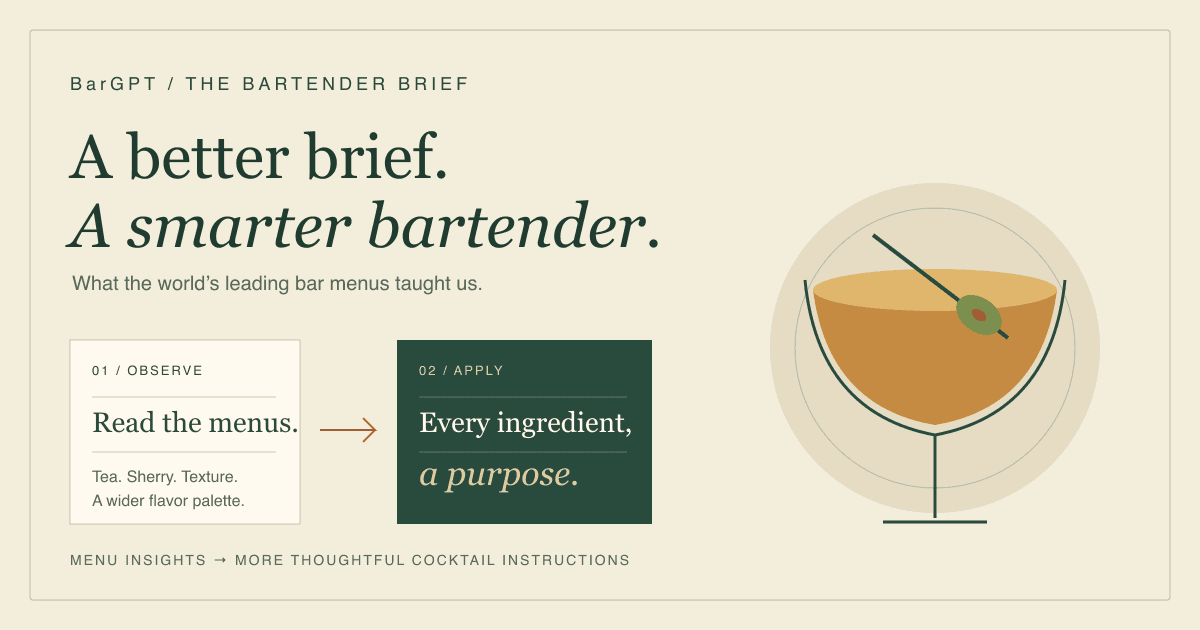
What should an AI bartender learn from the world’s best cocktail bars? We wanted to go beyond asking BarGPT to “be creative.” So we explored their menus, looked for recurring ideas, and turned those observations into more specific guidance for how BarGPT creates a drink.
The result is a new bartender brief: think about the structure of the drink, give every ingredient a job, explore a wider range of flavors, and keep the recipe practical for the person making it.
First, we read the menus
Our cocktail menu study explored 1,253 cocktail observations from 54 bars in 21 countries, drawn from the World’s and North America’s Top 50 lists. We looked at ingredients, named cocktail families and the preparation techniques menus chose to mention.
Some patterns were familiar. Others were deliciously unexpected. Tea appeared in 93 drinks, compared with 76 for coffee. Sherry appeared in 85. Mushroom and truffle ingredients reached 18 bars, while miso reached 11. There was plenty to learn beyond picking a spirit and adding citrus.
A bigger flavor vocabulary
We now ask BarGPT to consider tea alongside coffee, and vermouth, sherry and amaro alongside the more obvious juices, syrups and liqueurs. Those ingredients give the bartender more directions to consider when you ask for something dry, earthy, aromatic or bittersweet.
Savory ingredients get a place in that conversation, too. The guidance includes restrained accents of tomato, olive, sesame, miso, mushroom and toasted coconut when they fit your request. The key word is restrained: one clear flavor direction deserves room to come through.
You can explore those directions yourself in our tea cocktails and sherry cocktails.
Creativity needs a structure
Familiar cocktail names kept turning up on inventive menus. That gave us a useful design principle: choose a structure before piling on new ideas. BarGPT’s updated brief asks it to start with a suitable shape, such as a sour, highball, stirred drink, spritz or tropical drink, and use that to guide proportions and technique.
“Make each ingredient serve a purpose.”
We also ask it to review the recipe for overlapping ingredients, consistent quantities and a serving volume that fits the glass. These instructions are intended to produce a more focused first recipe, with fewer additions that contribute little beyond a longer shopping list.
Think about the sip, then the prep
The menus reminded us that a drink is more than its ingredient list. Clarification, fermentation and carbonation appeared repeatedly. We translated that into guidance to consider body, aroma, temperature, dilution and bubbles, along with sweetness and acidity.
At home, that should still be manageable. The brief defaults to accessible equipment and ingredients, reserves involved preparations for requests that warrant them, and asks for quantities, steps, time and yield whenever it includes a homemade component. If you ask for a simple drink, that preference comes first. Our guide to advanced mixology is there when you want to go further.
Zero proof gets a complete recipe
We found 109 explicitly non-alcoholic drinks across 28 bars. That inspired another instruction: when you request a mocktail, design its body, acidity, bitterness and aroma deliberately. Removing a spirit leaves decisions to make about the rest of the drink.
Tea, botanicals and savory flavors are among the directions the bartender can consider while respecting your alcohol restriction. For more ideas, read about the rise of mocktails.
Give the smarter bartender your brief
Your preferences still lead. The new guidance offers possibilities; it doesn’t require tea, miso or an elaborate technique in every glass. Try one of these requests, or adapt it to what you have:
- “Make a dry gin cocktail with a subtle tea note. Keep it to five ingredients and no homemade syrup.”
- “Create a savory tequila cocktail with one unexpected accent. I have a shaker and ten minutes.”
- “Make a zero-proof highball that is bitter, aromatic and refreshing, using supermarket ingredients.”
Create your next cocktail with BarGPT, or read our cocktail prompt tips for more ways to describe the drink you want.