
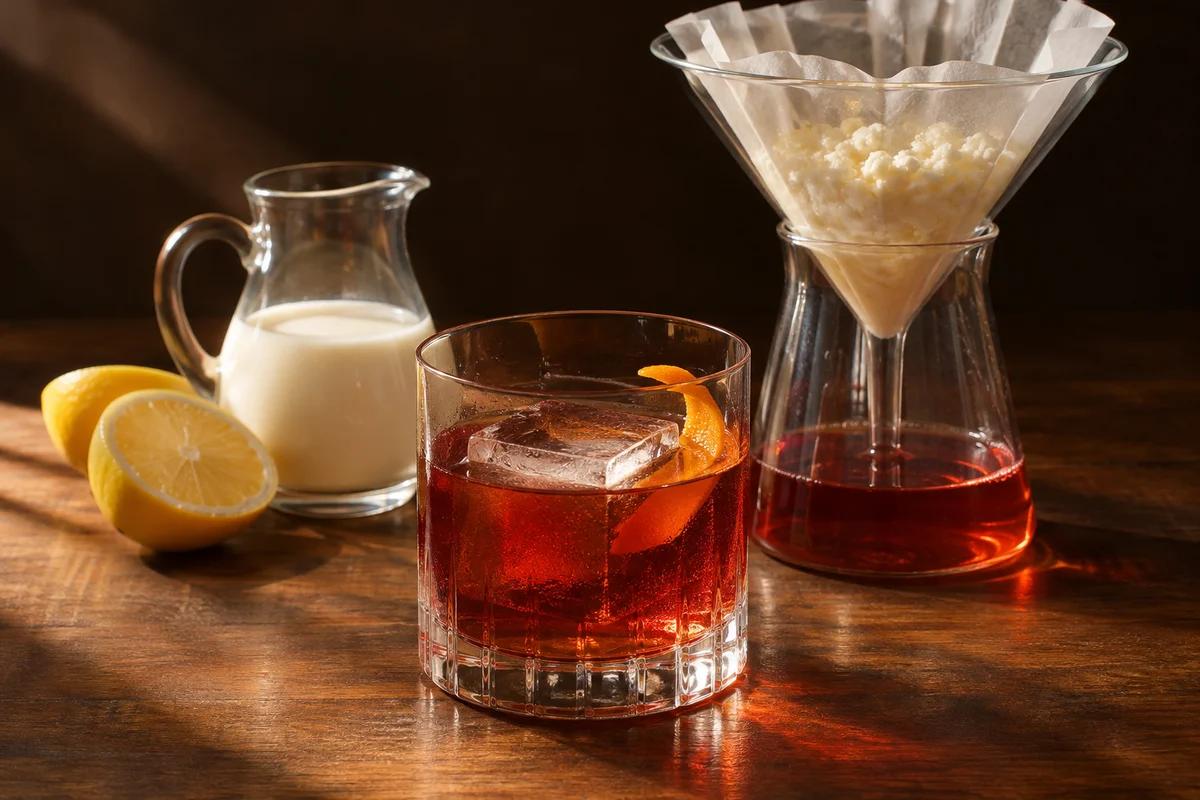
The first time you make a milk-clarified cocktail, the bowl looks like a mistake: flakes of curd floating in cloudy liquid. Keep going. Those curds help turn a punch into a transparent drink with a softer texture. The useful equipment is simple: a bowl, a strainer, a coffee filter, and enough time to let gravity work.
What Is Milk Clarification?
Milk clarification, often called milk washing, deliberately curdles milk in a cocktail and then removes the curds. It belongs to the tradition of clarified milk punch, which cocktail historian Dave Wondrich traces to at least the early eighteenth century. The finished drink is transparent and often silky. This differs from creamy milk punches served with the dairy still suspended in the glass. Tales of the Cocktail explains the history and broader clarification methods.
Clarity describes how light passes through the drink; it does not promise a colorless result. Alton Brown’s port-based milk punch, for example, retains a ruby tint. A colored ingredient can remain visible after the cloudiness disappears. His recipe demonstrates that distinction.
The Science Behind the Curds
Milk contains casein proteins dispersed in tiny structures called micelles. Acid changes their behavior: casein coagulates around pH 4.6. That is why lemon juice can turn milk into visible curds. Whey proteins remain in the liquid, along with dissolved components such as lactose. Filtering the curds does not remove everything that came from the milk. The University of Guelph’s dairy science text explains milk’s composition.
Casein also binds some phenolic compounds associated with bitterness and astringency. The curds collect into a filtering layer that catches suspended material. This can soften a tea-, wine-, or aged-spirit-based drink, but it changes its flavor as well as its appearance. Delicate notes may become less distinct. Campari Academy’s milk punch field guide describes the process.
A Practical Method for Home Bartenders
Start with a recipe designed for clarification. Whole milk is a straightforward first choice. For experiments, Campari Academy suggests milk equal to 25% of the cocktail’s volume before adding milk: 100 ml milk for 400 ml cocktail. This is a starting point, and individual recipes can use different proportions. Heating is optional in its method.
- Mix the cocktail separately. Combine the spirit, sweetener, juices, and any other ingredients specified before clarification. Keep the milk in a larger, separate vessel.
- Pour cocktail into milk. Add the acidic mixture slowly. Stir gently just enough to combine, then stop once curds form. Avoid shaking or breaking them into tiny pieces.
- Let it rest. Follow the recipe’s timing. Alton Brown’s method rests for an hour before filtering; allow additional time for the liquid to drain.
- Filter gently. Support a coffee filter in a fine-mesh strainer over a clean container. Pour carefully and retain the curds in the filter.
- Return the cloudy first portion. Once the drips run clear, switch receiving containers and gently pass the cloudy liquid back through the established curd layer.
- Chill and serve. Bottle the clarified liquid in a clean, sealed container and refrigerate. Follow the recipe’s serving instructions for ice and dilution.
That second pass matters: the curds do useful filtering work. Cocktail Chemistry’s walkthrough demonstrates straining through the collected curds, followed by a coffee filter. Plan this as preparation ahead of service, rather than a drink to start when guests arrive.
Example: Crimson Sleigh Ride
BarGPT’s Crimson Sleigh Ride brings dark rum, aged amaro, roasted beet juice, citrus, and warming spices together. The ingredient list supplied for this article calls for:
- 120 ml (4 oz) dark rum
- 60 ml (2 oz) aged amaro, such as Averna
- 45 ml (1.5 oz) fresh roasted beet juice
- 60 ml (2 oz) freshly squeezed orange juice
- 60 ml (2 oz) lemon juice
- 60 ml (2 oz) demerara syrup, made 1:1
- 1 cinnamon stick, 2 cloves, 1 star anise, and a pinch of ground nutmeg
- 240 ml (8 oz) whole milk
Here is how I would approach a clarification trial with those ingredients. This is an adaptation of the general method above, rather than a kitchen-tested preparation of the recipe. Use the linked recipe’s directions for preparing the roasted beet juice and infusing the spices; remove whole spices and strain coarse beet pulp before the milk step. Combine the non-milk liquids, then slowly pour them into the milk. Let curds form and rest, filter gently, and return any cloudy first run through the curd layer.
The lemon supplies a clear acid component. The rum, amaro, beet, and spices make this an interesting experiment in how clarification changes a layered drink. I would compare a small sample before and after filtering to see which aromas remain and how the amaro’s bitterness changes. A clear red result would still count as clarification, but the final shade and flavor need a real batch to establish.
Notice the milk proportion: 240 ml for 405 ml of other liquids is about 59% of the base volume, considerably above the general 25% starting point. Keep that distinction in mind before borrowing its ratio for another cocktail. The supplied recipe estimates four drinks and about 600 ml; its listed liquids total 645 ml before filtration, and some liquid will stay in the curds. Measure the finished batch before deciding portion sizes or scaling for a party.
Troubleshooting Your First Batch
- The first drips are cloudy: let the curd layer establish, then recirculate that portion gently through it.
- Filtering slows down: patience is part of the process. Avoid squeezing the filter or stirring the curd bed to hurry it along.
- Curds do not form: check the recipe’s acid component and milk proportions before changing the whole batch. Test adjustments on a small sample.
- The flavor seems quieter: clarification can soften character along with rough edges. Compare small trials before committing expensive ingredients to a large batch.
Milk Choices, Allergens, and Storage
Lactose-free whole milk can work, as Difford’s Guide notes for its vodka milk punch. It still contains milk proteins. Plant-based milks need their own tested recipes because their composition differs; they are not automatic one-for-one substitutes.
Label a dairy-clarified cocktail as containing milk, even when it looks completely clear. Campari Academy explicitly flags remaining dairy allergens. Ordinary milk clarification also does not establish that a drink is lactose-free. Keep finished punch sealed and refrigerated, and use storage guidance specific to the recipe. A long storage recommendation for one formula should not be transferred to an untested beet-and-citrus batch.
For a first attempt, make a small batch and leave yourself time to filter it twice. With Crimson Sleigh Ride, the most useful question is how the technique changes the balance of rum, bitter amaro, earthy beet, and citrus. Clarity is the visible result; the tasting comparison tells you whether the technique suits the drink.